

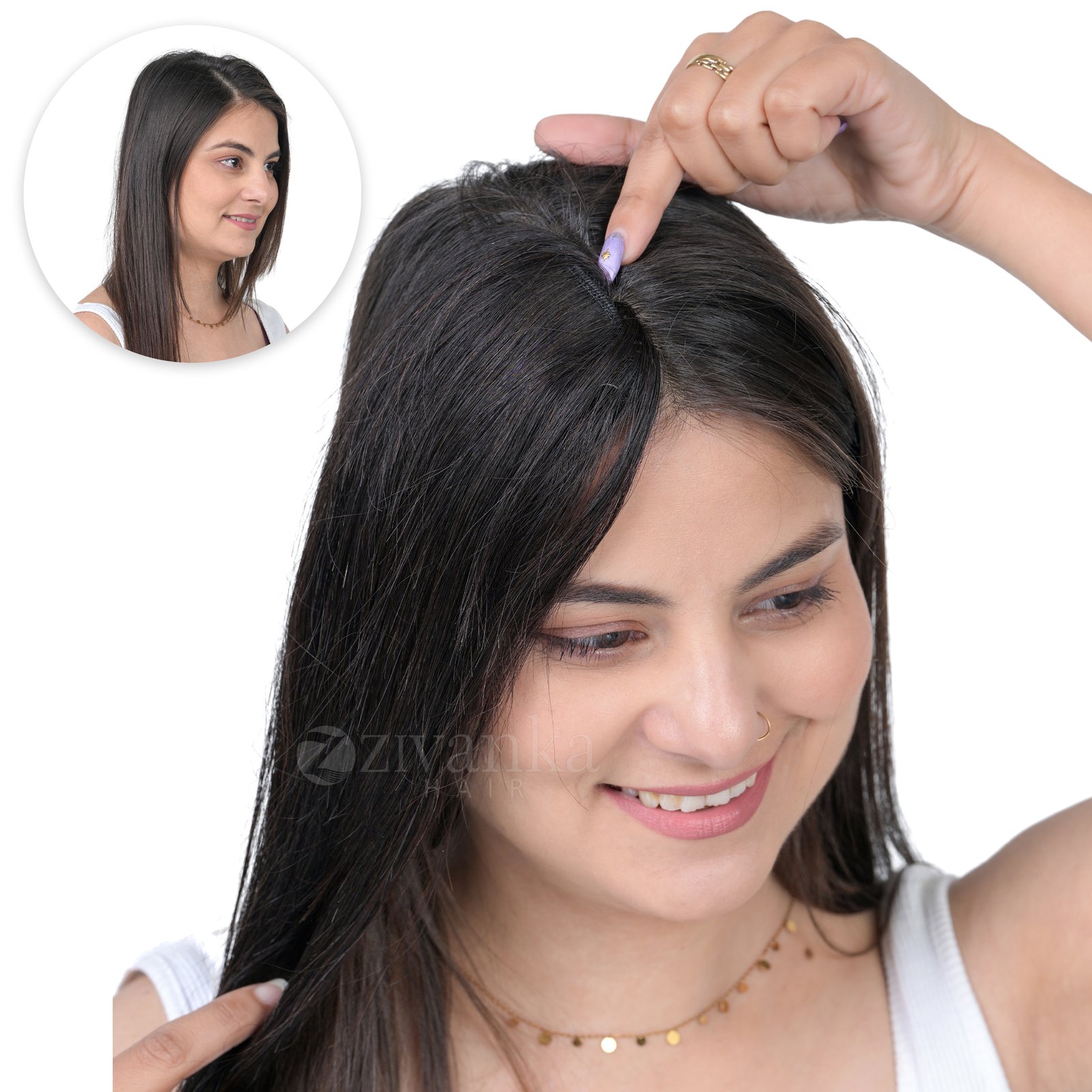
Some hair loss doesn’t need a full topper, let alone a wig. A defined thin spot at the crown, a patch near the front, one area where density quietly gave up — for these, the most elegant solution is the invisible hair patch: a compact, hand-knotted piece that covers exactly what needs covering and nothing more. Here’s everything you need to know.
What Is an Invisible Hair Patch?
An invisible patch is a small hairpiece built on a molded base backed with a diamond lace layer. Every strand of 100% Virgin Remy human hair is knotted in by hand, so the surface reads as scalp, and the molded construction holds a low, natural profile against your head. It clips securely over your thin area and blends into the surrounding hair — invisible in daylight, in photographs and in conversation.
Think of the difference this way: a topper covers a zone (the whole part or crown region), while a patch covers a spot. Zone problems get toppers; spot problems get patches.
Who Patches Are Perfect For
- A defined thinning spot at the crown that the rest of your hair almost — but not quite — covers
- Localized loss from traction damage, a scar, or patchy regrowth
- Front-area thinning where a realistic hairline matters most
- Anyone who found toppers more coverage than they actually need
The Zivanka Patch Range
Invisible Pro Hair Patch
The Pro patch is engineered with a realistic front hairline — the hardest thing to fake and the first thing eyes check. Choose Pro when your thinning touches the forehead line or parting front, where an ordinary patch would show its edge.
Invisible Bounce Up Hair Patch
The Bounce Up patch covers crown thinning while its shaped base adds root lift — coverage and volume in one piece. The pick when your crown is both thin and flat.
Classic invisible patches
The core range in multiple sizes and shades — straightforward, undetectable spot coverage for the crown and top.
Wearing a Patch: The 2-Minute Routine
- Brush your hair in its usual style and locate your spot
- Open the patch’s clips, position it over the area — front edge first
- Snap the clips onto the healthy hair around the spot’s border
- Blend your surrounding hair over the edges with fingers or a tail comb
- Check in daylight once; adjust; forget about it for the day
Patch vs Topper vs Wig: The Decision in 30 Seconds
- One defined spot → patch (smallest, lightest, cheapest to own)
- Whole part-line or crown zone thinning → topper (see our choosing guide)
- Severe all-over loss → wig territory
- No visible scalp, just less volume → volumizer or extensions, not coverage pieces at all
Why the Construction Details Matter
A patch sits closer to scrutiny than any other hairpiece — usually right at the crown where people glance down at you on stairs, or at the front line facing every conversation. Three construction choices make Zivanka patches disappear under that scrutiny: the molded base follows the head’s curve instead of tenting above it; the diamond lace backing keeps the piece breathable and flexible through a full day; and hand-knotted Virgin Remy hair matches the angle and swirl of natural crown growth — machine-made rows simply can’t imitate a crown’s spiral. It’s also why the hair takes heat styling and washing like your own: because it is exactly that, unprocessed human hair.
Care and Lifespan
Patches follow the same care rhythm as toppers: remove nightly, detangle gently from ends upward, wash every 8-10 wears with sulphate-free shampoo, air-dry, store away from sunlight. Heat-style at 150-170°C with protectant. With this routine a Zivanka patch delivers 11-12 months of daily wear — and because patches are small, care takes minutes. Every patch ships with free delivery across India, COD, and our 3-month quality guarantee.
Frequently Asked Questions
Will the patch show when the wind blows or in the rain?
A correctly placed patch is clipped to your own hair and blended over at the edges — wind moves the hair above it naturally, not the patch itself. Rain and humidity affect it like your own hair: some frizz, no reveal.
Can I part my hair through a patch?
Partings work through the patch area on hand-knotted pieces — that’s the point of the scalp-like base. For a parting exactly at the patch edge, position the piece so its edge sits under the parting side with more hair cover.
Patch clips on thin surrounding hair — safe?
Yes, with technique: clip onto lightly teased, product-free sections just outside the thin zone, rotate positions occasionally, remove nightly. The load of a small patch is a fraction of a topper’s — it’s the gentlest coverage piece there is.
How do I choose my size?
Measure the spot’s length and width, add 1-2 cm on each side for the clips to reach healthy hair, and match to the closest patch size. Between sizes? Go up. Send us photos and measurements and we’ll confirm before you order.
First-Time Buyer’s Checklist
- ☐ Spot measured (length × width) with 1-2 cm margin added per side
- ☐ Pattern confirmed: a defined spot (patch) — not a spreading zone (topper)
- ☐ Front hairline involved? → Pro variant with realistic front line
- ☐ Flat crown too? → Bounce Up variant for built-in lift
- ☐ Colour matched to mid-lengths in daylight, not roots indoors
- ☐ Photos shared with Zivanka’s team for a pre-order sanity check
Two Patch Myths, Retired
“Patches are for men.” The marketing history says so; the product doesn’t. Women’s crown and traction loss is exactly patch-shaped, and Zivanka’s range is built for women’s hair lengths, densities and shades.
“A patch will stop my hair growing underneath.” A clip-attached patch touches your scalp no more than a hat does, and comes off nightly. Follicles beneath continue their cycle undisturbed — and stay accessible to any treatment you’re using.
The Takeaway
The right amount of coverage is exactly as much as you need — no more. If your hair loss is a spot rather than a zone, an invisible patch restores it with the smallest, lightest, most economical piece possible. Explore Zivanka’s invisible patch collection, or read the complete topper guide if your thinning covers a wider area.