

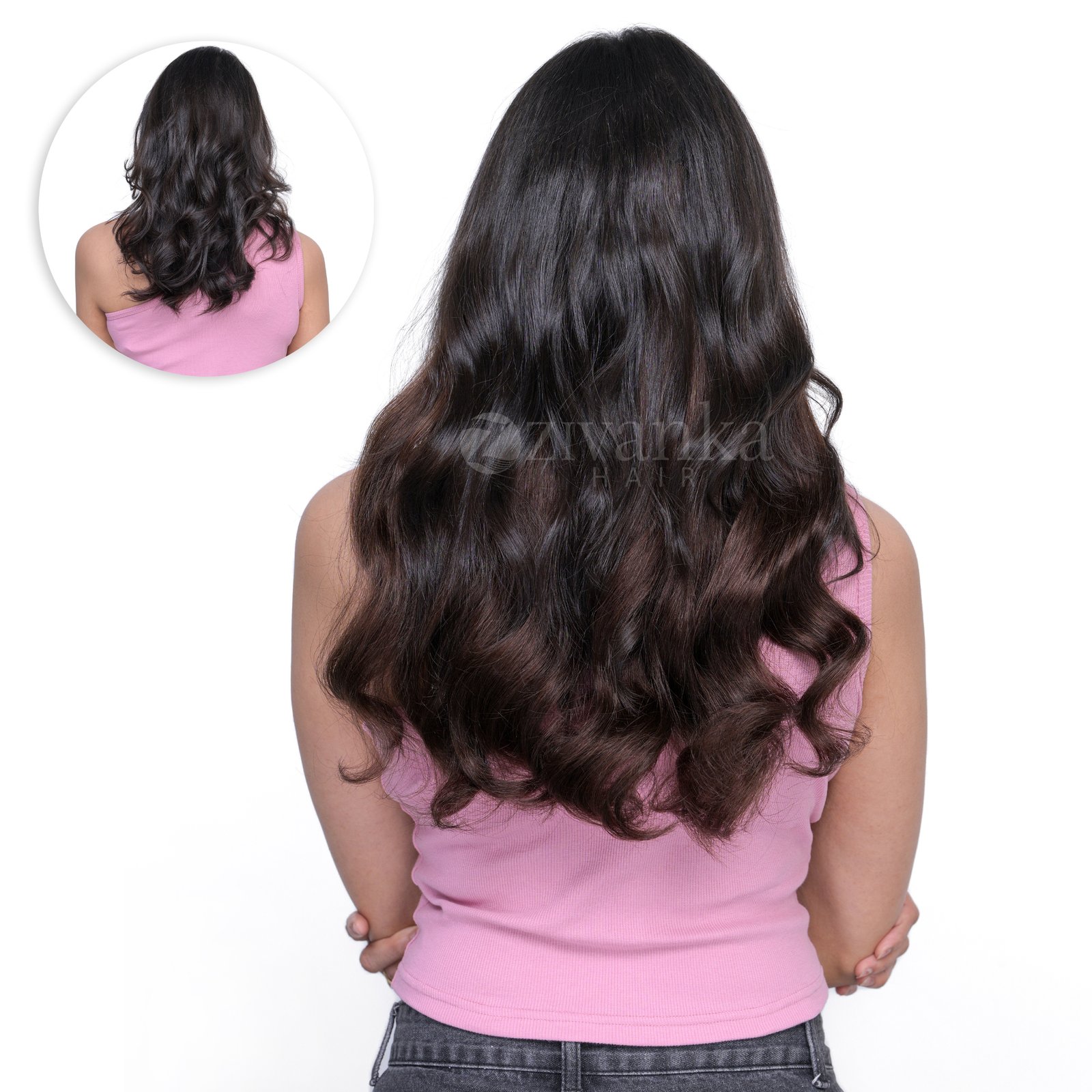
Shop for hair extensions anywhere and you’ll meet a wall of terms — virgin, Remy, non-Remy, human hair blend, heat-friendly synthetic — often attached to wildly different prices for pieces that look identical in photos. This guide decodes the terminology honestly, shows you how to verify what you’re buying, and explains why the difference matters more with every month you own the piece.
The Vocabulary, Decoded
Virgin hair
Hair that has never been chemically processed — no dye, no bleach, no perm, no smoothing treatments. Ever. It’s the strand as it grew, with its full strength and natural shine intact. This is the rarest and most valuable grade.
Remy hair
Hair collected so that all cuticles face the same direction, root to tip, the way they grew. Cuticles are microscopic shingles coating each strand; when they all point one way, hair stays smooth and tangle-free. When they don’t (non-Remy), strands rub against each other’s grain — matting is a matter of when, not if.
Virgin Remy — both together
Unprocessed and cuticle-aligned: the grade every Zivanka piece uses. Non-Remy hair is often acid-stripped of its cuticles entirely and coated in silicone to fake smoothness — glorious for two weeks, matted by week six as the coating washes off.
Synthetic fibre
Plastic filament (kanekalon, toyokalon and similar) engineered to imitate hair. It holds its factory style through anything — because it isn’t hair and can’t truly be restyled.
Side by Side: The Honest Comparison
Look and feel
Virgin Remy: moves, shines and photographs like your hair, because it is hair. Synthetic: a uniform, slightly wet-looking shine that reads artificial in daylight and flash photos; the strands feel subtly slick. Blending synthetic with your own hair is where the illusion collapses.
Styling freedom
Virgin Remy: curl it, straighten it, blow-dry it, colour it professionally — full freedom at 150-170°C. Synthetic: standard fibre melts under hot tools; “heat-friendly” variants tolerate low heat but hold poorly and never move naturally afterwards.
Lifespan
Virgin Remy: 11-12 months of daily wear for toppers, 2-3 years for occasional-wear clip-ins, with basic care. Synthetic: four to eight weeks of good looks, then irreversible frizzing at friction points — collars, shoulders, brush lines.
True cost
Synthetic: cheap to buy, expensive to keep buying — replaced every couple of months, the yearly spend quietly exceeds one quality set. Virgin Remy: a larger single investment whose cost-per-wear falls with every use. Extensions are one of those purchases where the economical choice and the premium choice are the same thing, just measured over a year instead of a day.
Where synthetic honestly makes sense
Fairness demands the other side: a one-off costume, a bold fashion colour for a single event, or trying a dramatic style before committing — for throwaway experiments, synthetic’s price is its virtue. The moment a piece becomes part of your regular life — daily toppers, weekly extensions, anything meant to pass as your own hair — the calculation flips completely.
How to Verify What You’re Buying
- The daylight test: real hair shines softly with dimension; synthetic gleams uniformly like doll hair
- The touch test: run strands between fingers — hair has microscopic texture; fibre feels frictionless
- The heat test (on a purchased piece, one hidden strand): human hair tolerates a warm iron; synthetic crisps instantly
- The price test: genuine virgin Remy cannot be very cheap — the raw material alone forbids it. A “virgin Remy” bargain is usually non-Remy hair in a silicone coat
- The seller test: honest sellers name their sourcing. Vague origins usually mean mixed-origin, processed hair
Where Zivanka Hair Comes From
Every Zivanka piece uses 100% Virgin Remy human hair ethically sourced from the temples of South India — hair devotees offer in tonsuring rituals, collected with consent and auctioned by temple trusts. Indian temple hair is prized worldwide precisely because it’s virgin by default: typically oiled, braided and never chemically treated through its life. We sort it by length and texture, cleanse it gently without stripping cuticles, and hand-craft it into extensions, toppers and patches. When we print “100% Virgin Remy” on a Zivanka box, that’s the supply chain behind the words.
Frequently Asked Questions
Is “human hair blend” a good middle option?
Blends mix some human hair into synthetic fibre — and inherit synthetic’s limits: the fibre portion still can’t take heat or restyling, and ages just as fast. Treat “blend” as synthetic with better marketing.
Why does some “human hair” mat within weeks?
It’s usually non-Remy: real human hair with cuticles stripped and silicone-coated. The coating washes off in a few shampoos, the misaligned strands grip each other, and matting follows. Cuticle alignment — the Remy part — is what you’re really paying for.
Can I dye Virgin Remy extensions?
Yes — professionally. Unprocessed hair takes colour beautifully, especially darker shades. Lightening is possible but risky; always salon, always strand-test.
How do I make premium hair last its full life?
Follow our clip-in usage habits and washing rhythm: gentle products, moderate heat, nightly removal, proper storage. Quality hair rewards basic care disproportionately.
Why Processing Ages Hair: A 60-Second Science Lesson
Every strand of hair is a protein rope wrapped in overlapping cuticle scales — its armour. Bleach and strong dyes work by forcing those scales open and dissolving pigment (or the rope itself, partially) inside. The scales never seal back fully: processed hair is permanently more porous, thirstier, weaker and duller, which is why heavily processed extensions feel like straw within months no matter how premium the branding. Virgin hair’s scales have never been forced open — the armour is intact, moisture stays in, shine reflects evenly. That single fact is most of what separates hair that survives years from hair that survives weeks.
Cost Per Wear: A Worked Example
Take a synthetic set at ₹1,500 that looks good for six weeks of twice-weekly wear — about 12 wears, or ₹125 per wear, forever, because each replacement resets the clock. Now take a Virgin Remy set at ₹8,000 worn twice weekly for two conservative years — roughly 200 wears, or ₹40 per wear, falling every month you keep it. The premium piece costs five times more at checkout and three times less in use — before counting the styling freedom, the natural blend, and never having that synthetic-shine moment in someone’s flash photo.
Reading a Product Listing Like an Expert
- “100% human hair” alone says nothing about Remy or processing — non-Remy stripped hair is technically 100% human
- “Tangle-free guarantee” on suspiciously cheap hair usually means silicone coating — smooth until the third wash
- Named sourcing (“South Indian temple hair”) beats vague claims (“premium European quality”) — origins that can be checked usually are real
- Weight and length listed precisely signals a seller who expects informed buyers
- A real guarantee period — companies that expect hair to survive stand behind it; Zivanka’s is 3 months
From Temple to Topper: The Journey in Five Stages
- The offering. At South Indian temples, devotees offer their hair in tonsuring rituals — an act of devotion practised for centuries. The hair is long, oiled through its life, and has typically never met a chemical.
- The auction. Temple trusts collect and auction the hair transparently, with proceeds funding temple charities, hospitals and community programmes — the reason Indian temple hair is considered the ethical benchmark of the industry.
- Sorting. Skilled workers separate the hair by length, texture and natural shade — and critically, keep every bundle root-to-tip aligned, preserving the Remy quality that arrived free from the ritual itself.
- Gentle cleansing. The hair is washed of its ritual oils in mild baths that leave cuticles untouched — no acid stripping, no silicone masking, the steps that define cheaper supply chains.
- Crafting. Wefts are stitched, toppers and patches hand-knotted strand by strand, colours blended into balayage sets — and the finished piece ships with the only label it needs: 100% Virgin Remy, and a supply chain that welcomes the question “where is this from?”
When you wear temple-sourced hair, the strand in your topper funded a meal programme or a hospital bed on its way to you. Few luxury products can say the same.
Bottom Line
Synthetic buys a look for an event; Virgin Remy buys hair for your life. If a piece is going to be worn, washed, styled and trusted to pass as your own, the grade on the label is the whole game — and now you know how to read it. Explore Zivanka’s Virgin Remy collection — free shipping across India, COD, 3-month guarantee.