

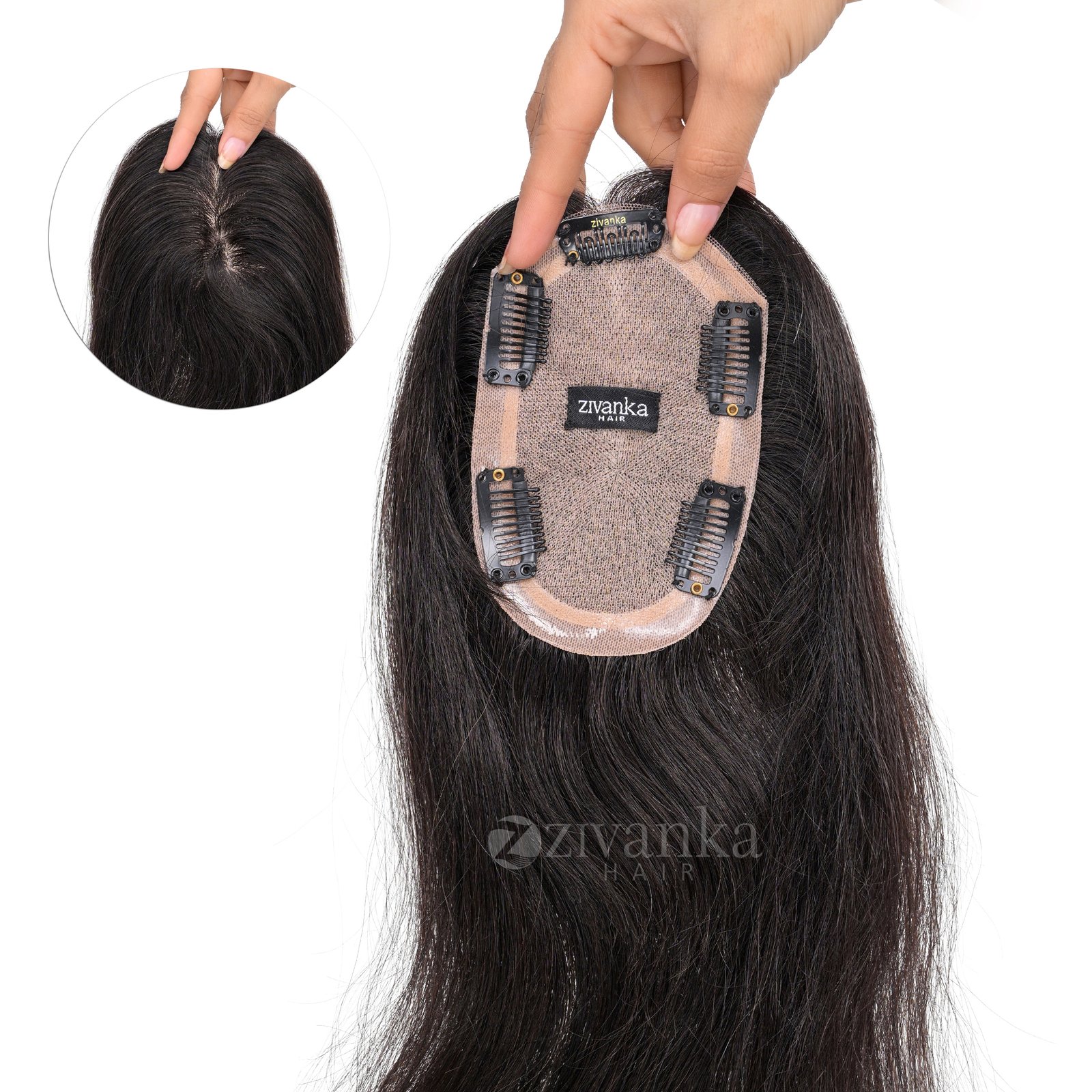
Ask anyone who owns a hair topper what they’d tell a first-time buyer, and the answer is almost always the same: get the size right. Colour can be adjusted, length can be trimmed — but a base that’s too small shows its edges and grips weak hair, while one far too large is unnecessary weight and cost. This guide shows you exactly how to measure, and what each Zivanka size is designed to cover.
What You’ll Need
- A soft measuring tape (a tailor’s tape, not a metal one)
- A mirror — or better, a friend for the back measurements
- Two clips or pins to mark boundaries
- Five minutes with your hair in its normal, everyday parting
Step-by-Step: Measuring Your Coverage Area
- Style your hair normally. Measure the thinning you actually live with, in your everyday parting — not a special arrangement.
- Mark the boundaries. In the mirror, find where visible scalp or low density begins and ends. Place a clip at the front edge and one at the back edge.
- Measure front to back between your two clips, following the curve of your head.
- Measure side to side across the widest point of the thinning area.
- Add the anchor margin: 2-3 cm (about 1 inch) on every side. Clips must close on hair with healthy density — never at the edge of the thin zone itself. This margin is the single most-skipped step and the most important one.
Your final number: thinning area + margin, in inches — that’s the base size you’re shopping for.
Zivanka Size Chart: What Each Base Covers
Our silk toppers come in bases from petite to full-coverage. Here’s what each is designed for:
- 1.5″ × 3″ / 1.5″ × 5″: part-line specialists — early thinning concentrated along the parting; nearly weightless
- 2.5″ × 3″ / 2.5″ × 4″: widening part plus early crown thinning; available with bangs for front-line coverage
- 3″ × 5″ / 3.5″ × 5.5″: the most popular range — noticeable crown and part thinning with comfortable coverage
- 4″ × 5″ / 4.5″ × 5.5″ / 5″ × 5″: advanced thinning across the top of the head — full top coverage while your sides and back stay natural
Between Two Sizes? Size Up — Here’s Why
A slightly larger base wins on every count. Its clips sit further into healthy hair, so grip is stronger and gentler at once. Its weight spreads over more area, so it’s more comfortable. And thinning, unfortunately, tends to progress slowly — a size with room to spare stays useful for years. The only cost is a few grams of weight you won’t notice.
Don’t Forget Hair Length
Base size covers your scalp; hair length decides the blend. Measure your own hair from parting to ends. A topper that’s equal to or 2-5 cm shorter than your natural length blends seamlessly. Much longer than your hair, and you’ll need a blending trim (which works fine — just budget for the salon visit).
Three Sizing Mistakes to Avoid
- Measuring flat instead of over the curve — always follow the head’s shape with a soft tape, or you’ll under-measure
- Skipping the margin — a base that exactly equals the thin area clips into the thinnest hair you have
- Buying for today only — if your thinning has visibly progressed over the past year, factor that trajectory into your size choice
Frequently Asked Questions
My thinning is only at the front hairline. Which size?
Front-line thinning is better served by a topper with bangs (like our 2.5″ × 3″ with bangs) or an invisible patch with a realistic front hairline — measure the same way, but tell us it’s front coverage you need.
What if I measure wrong and order the wrong size?
Zivanka’s team checks your measurements against your photos before dispatch if you share them, and every topper carries our 3-month guarantee. When in doubt, send us your numbers — we’ll confirm the size before you pay.
Does base size affect how the topper attaches?
Larger bases carry more clips (spreading grip and weight), smaller bases fewer. All sizes use the same pressure-sensitive clips and work with adjustable bands if your front hair is fragile.
How Density Interacts with Size
Base size decides where coverage goes; density decides how much hair delivers it. The two work together: a correctly sized base with density close to your own hair looks grown-in, while maximum density on any base reads as a hairpiece. Match density to the hair just outside your thinning zone — your sides and back are the reference, not the hair you wish you had. If your natural hair is fine, choose light-to-medium density even on a large base; the goal is for the transition from topper hair to your hair to be a gradient nobody can find.
Your Measuring Checklist
Screenshot this before you measure:
- ☐ Hair styled in my normal everyday parting
- ☐ Front and back edges of thinning marked with clips
- ☐ Front-to-back measured along the head’s curve: ____ cm
- ☐ Side-to-side at the widest point: ____ cm
- ☐ Added 2-3 cm margin on every side
- ☐ My hair length, parting to ends: ____ cm
- ☐ Photos taken in daylight (for colour matching or sharing with Zivanka’s team)
Sizing for Patches vs Toppers
The same five measuring steps work for invisible patches, with one difference of philosophy: a patch is sized close to its target area for discreet, targeted coverage of a specific spot, while a topper is sized generously for zone coverage of the part or crown. If your thinning is one defined patch — a spot at the crown, a section near the front — measure it, add a small 1-2 cm margin, and look at patch sizes. If it’s a zone that’s thinned overall, use the full 2-3 cm margin and shop toppers. When your measurement could go either way, the deciding question is future-proofing: zones tend to spread, spots tend to stay — choose the category that matches your pattern’s history.
Reading Your Own Measurements: Quick Interpretations
- Under 2″ wide, along the parting: part-line piece (1.5″ bases) — you need density, not coverage
- 2-3″ wide, centred on the crown: the classic mid-size topper territory (2.5″-3.5″ bases)
- Over 4″ in either direction: full-coverage bases (4″-5″) — and worth a conversation with our team about density
- A defined spot rather than a zone: look at invisible patches before toppers
- Front hairline involved: bangs versions or the Pro patch with realistic front line
Measured up? Browse all hair toppers by size — and read our complete topper choosing guide for colour and base-type decisions. Free shipping across India, COD available.